

ABSTACKTION, episode 2
A discussion of Anna Kornbluh's IMMEDIACY OR, THE STYLE OF TOO LATE CAPITALISM


Hi. If you’re here, you probably got through at least enough of my last post to glean that Abstacktion is my modest, mostly recreational stab at learning something about art in our era of overabundant information.
The Sitch You know
Things pretty much do be this way: platform screens made up of largely indistinguishable pictures are where nearly all of the new artwork we see is first displayed. Media corporations have decided it’s easier to guide audiences toward wanting the same things than it is to write algorithms capable of accounting for human individuality. In a shift reminiscent of photography’s invention, AI has simultaneously freed artists from certain constraints and erased much of art’s apparent value. Social media has priced out most spaces of political voice, rendering publicly accessible protest art a Faustian bargain.
These examples describe the conditions of visual communication today. The effects of these conditions range from the largely inconsequential, yet annoying, “midness” of most streaming content, to the criminalization of pro-Palestinian voices on US campuses while X amplifies celebrity-led neo-Nazi hate-memes. We’ve seen the waning of electoral viability under ultra-manipulative digital advertising campaigns, the political abandonment of climate progressivism in favor of guaranteed next-day delivery, and the integration of AI into video games and (relatedly) border security. People have become confused and vulnerable in their desperation for understanding, subject to annexation of the brain by conspirascammers like QAnon and Christian extremists like The TheoBros.
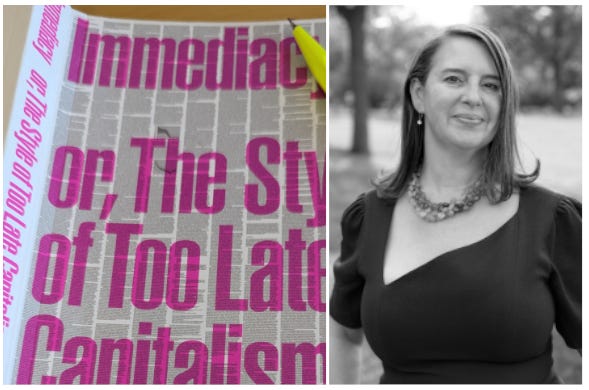
The list goes on. But my point here isn’t just to sketch out a hopeless rendering of our collective circumstances. It’s to introduce, by way of examples, the new historical epoch Anna Kornbluh describes in her most recent book, Immediacy or, The Style of Too Late Capitalism.
The Book
To start off, I’ll say that I had a great time reading Immediacy. As much as Kornbluh questions the underpinnings of our overstimulating, dopamine-chasing media environment, her writing remains full of internet easter eggs and quippy puns. And for a text that occasionally diverts for significant passages into fairly granular discussions of economics and philosophy, I felt like Immediacy remained grounded by focusing on descriptions of today’s aesthetic style.
The text is chock-full of highly effective examples, and we get a great one early on as we find ourselves commanded through some kind of yogic exercise:
“Standing at the edge of your mat, bring your arms out to the sides and up to the sky, joining your palms above your head, then relax your shoulders and lift your gaze to the sun. Its blazing rays swirl, thick brushstrokes animated, seventy-five high-definition projectors scaling wall to wall, floor to ceiling, 500,000 cubic feet of psychedelic wallpaper pinned to crescendos of digitally synthesized pop.”
This is the experience of a participant in “Van Goghga,”[1] a yoga class that takes place inside the augmented-reality art installation “#ImmersiveVanGogh,” an exhibit that’s popped up in a large number of galleries and museums across Europe and America over the past five years. It essentially encapsulates what Kornbluh calls “Immediacy Style.”

Without anything more, you probably already get what she’s talking about.
Don’t overthink it, now. It’s vibes.
It’s when a TV show expresses so much thematic overload—sex and horrifying violence, or the sickly ecstatic colorways of adolescence in an ultracontemporary suburbia—that as an audience we know our role is to binge it. It’s when someone has so many social media posts it seems like they just happen on their own. It’s when year after year, the trendiest novel of the summer is a story about “stuff that really happened” to the author… but changed a little. Immediacy Style is when a show of paintings by probably the best-known artist in history becomes so “immersive” that our bodies can actually meditate inside of them.

All of this is at once a little cringe and exactly what we want. We all know that Game of Thrones was almost goofily over the top, but there was something about its gratuity that was also kinda smart? Instagram is like a real job now, which is a gigantic downer because suddenly we’re all employees of proto-incel Mark Zuckerberg, but nonetheless, we can still learn something from people who are good at posting. Maybe you do, or maybe you don’t, hanker for a yoga session on the floor of a warehouse-sized 3d rendering of Starry Night, but everyone is definitely entertained to learn that it’s possible.
These aren’t contradictions. They are aspects of media that, when taken together, create the appearance of art and entertainment naturally emerging from the ambient culture around us, manifesting “in the moment,” and not by the design of any particular person or group of people.
Kornbluh calls this “the paradox of Immediacy,” a “style that imagines itself unstyled.” When we see it, we might point to its vibes. But Kornbluh rightly observes that projects such as these cannot “naturally emerge” from anywhere, let alone something as vibey as a “moment.”
So where do they come from? And why now?
What’s Too Late Capitalism?
The title Immediacy or, The Style of Too Late Capitalism is a barely encrypted reference to cultural critic Fredric Jameson’s 1991 analysis of art and architecture in post-industrial society, Postmodernism, or, The Cultural Logic of Late Capitalism. It will probably be helpful to briefly touch on Jameson’s idea of “Postmodernism” to clarify what exactly Kornbluh is trying to talk about with “Immediacy.”
Academics, bite down on something hard. I’m about to be concise:
Modernist art is about the expression of the artist’s feelings or their perspective on the world.
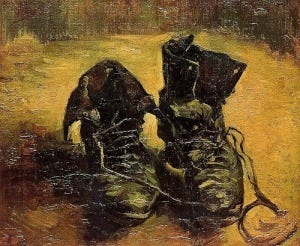
Vincent Van Gogh’s Shoes (Schoenen), 1886 — Modern Postmodernist art is without fixed meaning, acting on its own in the world, much like whatever else gets sold, bought, or encountered by the public.

Andy Warhol’s Diamond Dust Shoes, 1980 — Postmodern

Jameson identified a number of cultural traits definitional to Postmodernism that we won’t go into here, but overall, he was very concerned with the tendency of capital to commoditize important markers of historical eras (like Expressionism, Art Nouveau, Rock and Roll), and what would happen to a society that communicated in symbols lacking their historical contexts. Jameson’s conclusions are complex, and not as pessimistic as you might expect. But a lot’s happened since ’91 (for instance, my entire life).
And everything that’s happened since 1991 is what leads Anna Kornbluh to declare Late Capitalism over and Too Late Capitalism well underway. With the many markers of dystopia surrounding us, Too Late Capitalism probably doesn’t require that convincing of an explanation, but in Immediacy we get one anyway, and Kornbluh’s handiest tool for the job is the Marxist formula for “circulation.”
Economists grit yer chompers. I’m about to oversimplify:
For capitalist economies to function, commodities have to be sold for money, and that money needs to be reinvested in other commodities, resulting in commodity-to-money exchanges (or: sales) and money-to-commodity exchanges (purchases).
But money can also be exchanged for other money. This occurs under the auspices of, for example: credit, debt, and investment. When money is exchanged for money, Marx asserts, it becomes “capital,” and it reduces the need for labor power to actually produce commodities in order for value to move around. But, in essence, the smaller the fraction of the economy there is that’s driven by labor and commodity production, the lower the overall rate of growth in that economy. Eventually this results in Kornbluh’s key observation, and one that many have been cringing at since roughly the forties, but really freaking out about since the eighties; a phenomenon economists refer to as “Secular Stagnation.”
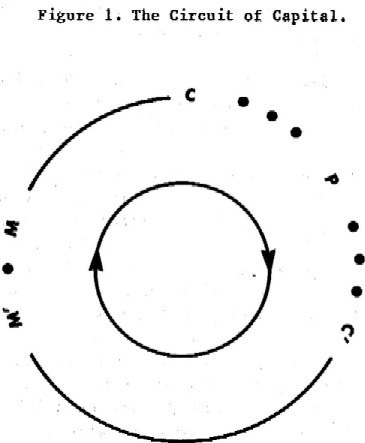
Secular Stagnation is the near stalling of growth in mature capitalist economies after long abiding by the mantra: Do not pass go, do not produce material wealth, go directly from money-to-money.
Kornbluh writes, “This world-market, saturated-consumption, automated-production, expelled-population scenario is what Marx referred to in part III of Capital as ‘the law of the tendency of the rate of profit to fall.’” More direly—because it’s less reparable—Kornbluh highlights how massive economies experiencing Secular Stagnation might start looking to reestablish value in the form of commodity production. Unfortunately for them, cheap access to material resources (fossil fuels, agricultural land, etc.), which is required for commodity production, either no longer exists or won’t exist soon. So for the working classes of “developed nations,” participation in the economy does not result in more jobs, and the looming scarcity of resources threatens to drive what little wealth distribution still occurs to a screeching halt.
Whether or not you agree with this assessment, it’s simply intended to illustrate how Kornbluh is using the “too late” in Too Late Capitalism to imply that there are no solutions to this paradox that involve the survival of capitalist economies.
Hey, what about the pick-chahs?
If you are still reading this, I love you. I promise, like capitalism, I’ll hurry up now.
Here’s the trajectory Immediacy describes: Per Jameson, post-industrial, globalized capitalism—the growth of which was supported primarily by money-to-money exchange—resulted in the “cultural logic” of Postmodernism. Now, the unsustainability of that model has brought about Too Late Capitalism, and the “cultural style” of Immediacy.[2]
Kornbluh argues that capitalists have attempted to solve the issue of Secular Stagnation, at least for themselves, by accelerating the process of circulation as fast as possible, to the point where anything that takes time is devalued and disincentivized. Relevant to an arts context, this includes any media that can’t be understood at a glance, and on its own terms, without requiring analysis beyond its surface appearance.
High frequency trading is an often-cited example of the accelerating economy, but Kornbluh also brings up the turn from commodities to “services,” like Uber, Airbnb, and Amazon’s overnight delivery. These, she explains, represent somewhat desperate attempts at value creation without a need for new production. Moreover, these services are made possible by the loss of the traditional jobs that they themselves obsolesced. Contemporary labor has created a class of workers branded as “entrepreneurs,” who are actually just selling their time—which before had been “free,” after-work time—directly to consumers for the benefit of companies that do nothing more than own the metaphorical space (usually an app or a website) where such an exchange has been made possible and necessary.
Social media is, of course, immediate exchange par excellence. Kornbluh writes, “Over one-third of the earth’s population uses Facebook; the platform teaches these individuals to think of themselves as image managers and avatars, performing exhaustive unwaged digital labor as brand-identity consultants and data producers.”
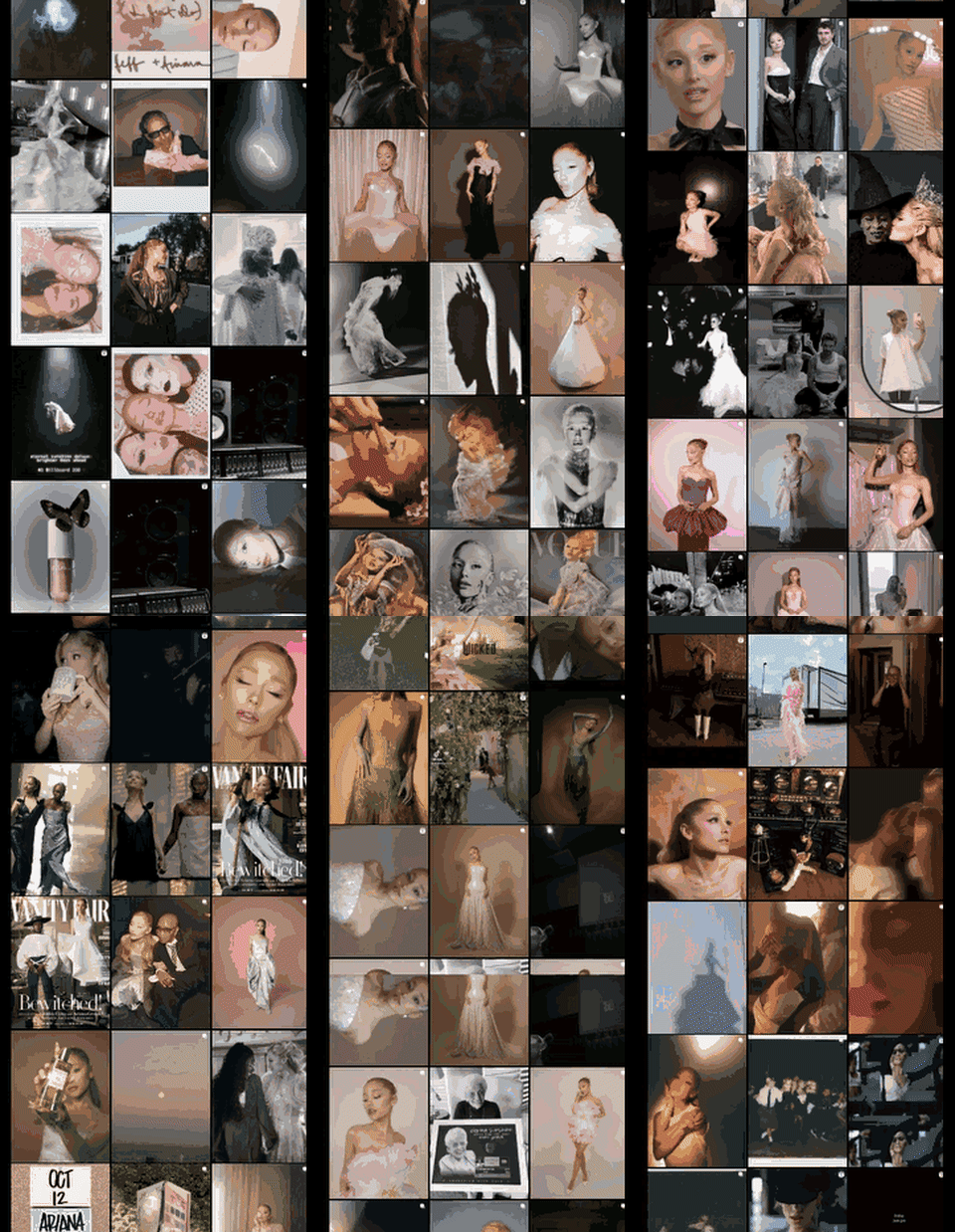
Here we have the signature character of our public participation. Those of us who consume media always also produce it. Oftentimes, this results in there being no real “middleman” between the source of inspiration (like someone going to the gym, feeling amped, and snapping a selfie), and the ultimate viewer or consumer (the person who hearts that selfie on Instagram and feels—let’s hope—just as amped).
The essence of Immediacy for Kornbluh, and for phenomenological philosophers working after Kant (which we will not get into now), is the lack of, or apparent lack of, “mediation.”
“Mediation” is what I am doing at this moment. I am taking someone else’s ideas, I am writing a response to them, and I am presenting them to an audience in a different context. Traditionally, this is what “media” has accomplished. It repackages direct experience through techniques like fiction, theater, journalism, criticism, and art. Kornbluh reveals how one reason contemporary culture selects for Immediacy is that we’ve become so accustomed to depictions of experience reaching us in apparently unmediated fashion (gym selfies are not fiction, theater, or art) that we expect our media to present itself as similarly unauthored, even though media being unmediated is a bit of a contradiction in terms.

And it’s not just that all media evolves to imitate the dominant form of the social network. It’s also that our economy is desperately seeking more and more opportunities to circulate value—because, remember, production has ceased to cut the mustard and grow large-scale economies.
Capital therefore requires its consumer/producers to spend more and more of their precious lives involved in acts of economic exchange, just to maintain a status quo. What before we might have referred to as “leisure time,” which, if not outside the economy, was at least not dedicated to producing exchange value for an owner class, has been increasingly made “useful” to advertisers and data-brokers who rabidly speculate on a trove of invisible money derived from quantified selves who are sold back and forth to each other through a network of images (“real” images, like photos and videos, but also snippets of language so bluntly consumable that they might as well be thought of as images anyway).

Kornbluh writes, “Plate the dinner, frame the photo, upload it to the hashtag, bank your brand—and thus fetishistically elide the economic relationships of data analytics.” Here she pulls a term from Communication Studies and calls this compulsion to refine value from private experience: “visibility mandates.” These, she adds, “lead individuals to misperceive digital architectures as their own self-expression.” She does NOT say, don’t JUST read my book, write about it on Substack, but she doesn’t have to; she knows I’m too worried about the future not to liquidate my thoughts somehow or another.
The Rest
What I’ve just outlined comprises some of the points in the first three chapters of Immediacy, which serve as an extended overview of Kornbluh’s theory about today’s dominant style and the material conditions that have made it so ubiquitous. The remainder of the book is divided into three media-specific sections, “Writing,” “Video,” and “Theory.” In these we are shown many, many examples that readers will be mostly familiar with. Some of them, like Phoebe Waller-Bridge’s Fleabag, may already hit a little like blasts from the past. But it takes a long time to write and publish a rigorously researched book. Immediacy did not feel outdated to me, though others have leveled that criticism, which, to my view, kind of proves Kornbluh’s whole point.

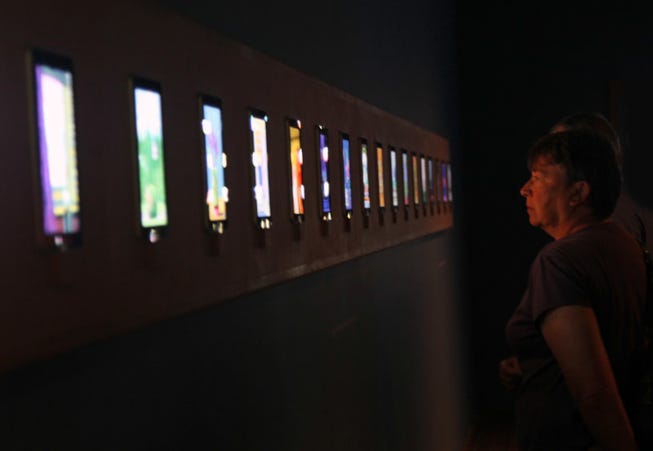
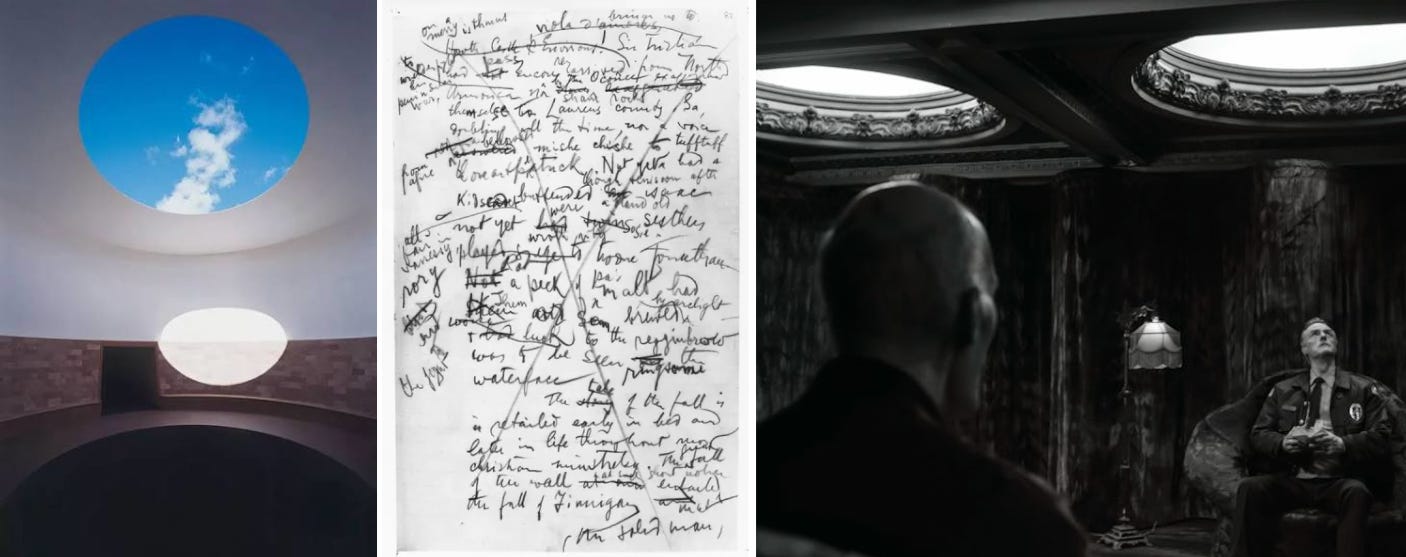
In the final two chapters, the book attempts to define a small lexicon that could be used to move past Immediacy Style. Kornbluh gives us three terms by which to value non-immediate artwork and media:
Scale – big projects that make no bones about taking a lot of time and effort to complete. These do not just “manifest.” They are painstaking endeavors that, in their forms as media, might stand a chance of transcending the fate of mere datapoints.
Impersonality – Kornbluh values third-person narration and indirect discourse. She claims that we need these tools if we want to imagine the significance nascent in the world outside our personal experiences. Otherwise we are stuck perpetually in the present.
Hold – this quality makes the claim that art should be, if not necessarily grueling to understand, maybe not always instantaneously comprehensible. In my opinion, this is very similar to what a lot of people would think of as “depth.” But “hold” better describes how audiences play a role in validating work that is deep.
I recognize that this post might inadvertently depict Immediacy as a more negative text than it really is. But for her efforts to write the book in a mostly descriptive mode, it remains obvious that Kornbluh is not totally stoked about “Immediacy Style” completely taking over the communication and culture of our age. Still, the book is not nihilistic, nor is it uncharitable towards any of the citations. I think Kornbluh probably enjoys much of the TV, film, and writing that serve as examples of Immediacy. I also believe the voice of her writing, which demonstrates her flagship qualities of Scale, Impersonality, and Hold to an impressively high standard, should appeal to a variety of readers, especially the middle chapters focused on concrete examples. Each of those could easily be read as an individual essay, and it might not be crazy to start there if you’re turned off by more weedy discussions of Marxist philosophy.
And here I’ll allow this weedy discussion to slowly simmer out. I hope it’s provided at least a few jumping-off points for anyone interested in exploring the causal networks underpinning the types of images that permeate our feeds, streams, screens, and pages. I profoundly encourage everyone to check out Anna Kornbluh’s book, and if you have questions or comments, never fear to post them right below! For real, I’ll respond.
Keep your eyes peeled for the next episode of Abstacktion. It may or may not demonstrate Scale, Impersonality, and Hold, but it definitely will attempt to examine the collective human act of “searching,” which we’ll do through Vilém Flusser’s essay The Gesture of Searching. As Google begins to buckle at the seams and AI claims to assume the responsibility of humanity’s “Deep Research,” I think this will be a good one to revisit.
[1] Kornbluh’s epithet. Not the officially advertised title of this activity.
[2] Why Kornbluh wants to shift the language to “style” rather than “logic” is something I will leave to be discovered by those who read the book.