

ABSTACKTION
Episode 1

What’s Abstacktion?
Over the past couple of years, I’ve wound up in more than a few arty/political discussions that concluded with somebody proclaiming, “We need a new Ways of Seeing.” This is a reference to the 1972 BBC series by John Berger that’s been standard viewing in art school history, design, criticism, painting, and photography departments for the last 50 years. In the program, Berger outlines a body of ideas that threads together an updated interpretation of Walter Benjamin’s epoch-defining The Work of Art in the Age of Mechanical Reproduction, along with the nude female subject and the male gaze (crystalized by Laura Mulvey in Visual Pleasure and Narrative Cinema), and a theory of the transition from art into advertising that synthesizes much of what Adam Curtis did thirty years later in his Century of the Self docuseries, in which a unified theory of the western individualism is traced back through a history of psychoanalysis and marketing.
Berger’s Ways of Seeing runs for a total of only two hours, and every time I watch it I’m blown away by how accessible, concise, and accurate it seems; what a radical hop forward it must have spurred in media literacy. Berger was a dedicated Marxist, and you can see in these videos an effort to digestibly explain critiques grounded in class analysis to broad audiences. You can also see Berger’s parallel mission of steering art production away from commodified desire and status symbols.
In 2010, like so many other young art students, I developed a pernicious curiosity in response to Berger’s work that’s kept my radar sweeping for new thoughts as to what the images that comprise our world can tell us about the way culture operates. As Berger puts it, when we discover these subtexts, “we shall also discover something about ourselves and the situation in which we are living.”
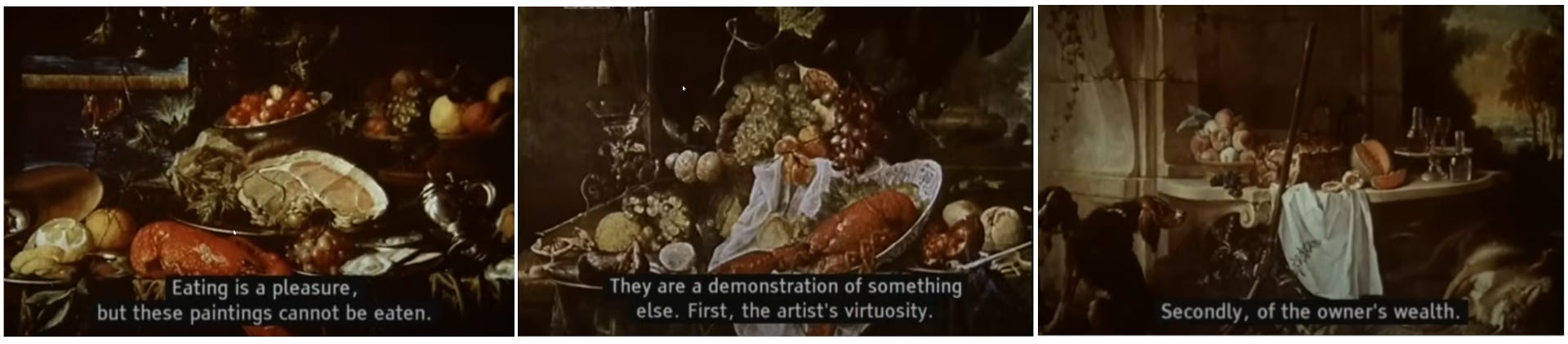
Berger was ahead of his time in many respects, but there’s one in particular that translates aptly to the media environment of our era. Generally, his strategy was to proffer and juxtapose ideas without much judgment or comment. His programs, essays, and most of his books were ultra-accessible and, to many, entertaining. To achieve this register, he left out a lot, but in doing so Berger effectively harnessed the power of the gist, reserving plenty of space for audiences to continue learning in their own ways. Nowadays, I—and I think most people—look to content creators online for a similar service, not necessarily for thought provoking opinions, or takes (which have withered into cringe), but for “mediation.”
This is something I’d noticed about my students as far back as 2022. They would go (and I often now go) through at least three phases of media consumption:
Phase I: Search. This is where we decide whether we even want to bother reading an article or watching a film by first tracking down a podcast, video essay, or Substack that describes the media in question and also provides some context. Often these are presented in the form of a discussion with a cohost, a jump-cut-loaded monologue, or a curt posticle attempting to answer the question of why said media is trending in the first place.
Phase II: Encounter. If during Phase I we come to suspect that our choice of media contains more ideas than can be easily articulated by a single podcast host, youtuber, or lifestyle journalist, we now proceed, sincere in our curiosity, to the primary source.
Phase III: Authenticate. After reading, watching, or listening to the media itself, we still need to verify its niche in our ecosystem of content. For this, we’ll usually return to our library of apps and platforms in order to discover with whom our understanding of the material best aligns. This will tell us how to categorize what we’ve learned, and it might give us some clues about how we should react.
While I don’t believe most of us have yet grown to need all this secondary media in order to construct our own readings of primary sources, the whole layered process of engagement occurs with such frictionless reflex that our individual responses can’t help but form amidst a crowd of online voices who are all discussing the things we’re privately thinking about.
I’m sure there are enough complex causes behind this shift in engagement to fill a generation of pop-academic hardcovers, but to gloss over most of them with careless transience: we’re dealing with something that could be described as information inflation.
Which is just to say that an economy exists where information constitutes currency, and those who regulate the distribution of information are engaged in efforts to create more of it. So information is both growing in abundance and shrinking in value, resulting in new types of circulation and production. As a producer and circulator of information myself, I’ve had some questions about my role in this system, and maybe you have too. Some examples could include:
How does the information economy influence, or even determine, the types of images we consume and produce?
What roles do we play in the information economy when we make images or view them in the ways that we do?
What are some possible approaches to artmaking and viewership that remain outside of this system?
If you are interested in art, or if you’re worried about AI slop and stuff like that, or if you’ve been frustrated by the homogeneity of “for you” recommendations made by an algorithm (or if you’re not quite sure what it means, really, for something to be “made by an algorithm”), or if you’re a working artist and you can’t figure out who the audience is supposed to be these days, or if you’re an undergrad liberal arts student thinking about ditching higher ed in favor of some Discord-based pyramid scheme “career,” these questions are relevant to you.
In this series, Abstacktion, I’m hoping I can serve as a helpful facilitator for “Phase I: Search” in a media journey through some important writing by authors who are attempting to provide answers.
The Deets
The texts that I’m going to begin with are: Immediacy or, The Style of Too Late Capitalism, by prominent film and literary theorist Anna Kornbluh, The Gesture of Searching by the late Brazilian philosopher Vilém Flusser, and Disordered Attention by one of our most influential critics of contemporary art, Claire Bishop.
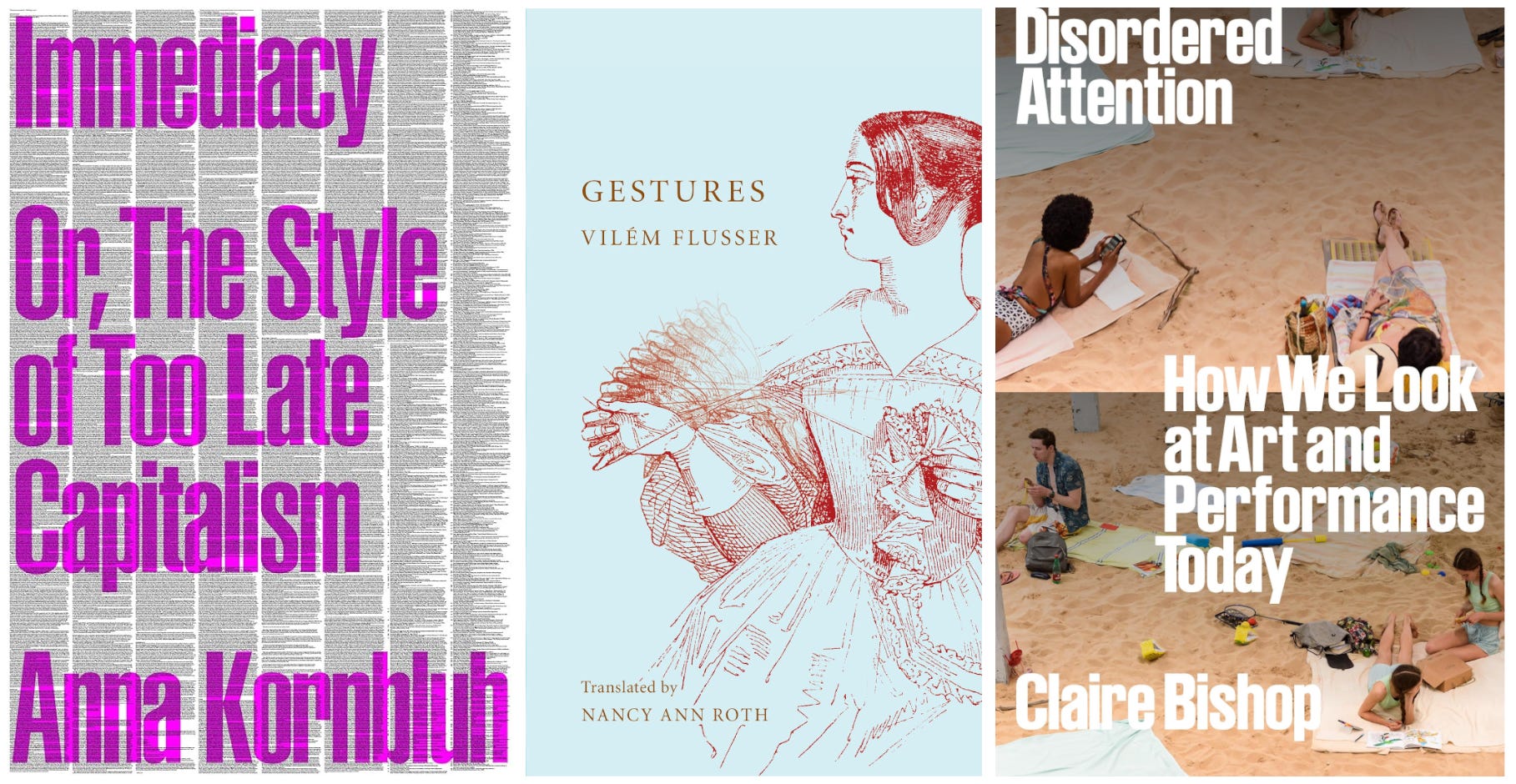
Over the next few weeks, I’ll first be running through the main ideas put forth in Kornbluh’s book, which focuses on how a crisis of value circulation in the digital economy has ushered in an era she calls “too late capitalism.” The conditions of this era, Kornbluh argues, have pushed video, literature, and art theory towards a style of “immediacy.” Put super simply, Kornbluh’s idea of Immediacy Style rejects the trappings of traditional media like books and film in favor of immersive, fourth wall shattering, genre melting “style that imagines itself un-styled.” There’s a lot to unpack in this book, but Kornbluh writes with adventurous flair, and I’ll try to present some of the overarching concepts in a way that allows readers to hand pick what feels most important to them.
Next, we’ll discuss the final essay in Nancy Ann Roth’s translated collection of Vilém Flusser’s essays, Gestures, which is titled The Gesture of Searching. This will build up scaffolding for some of the positions taken in the following book. Beyond that, The Gesture of Searching can serve as an opportunity to explore a concept Flusser suspected could be the primary challenge to our modern age, “the technical image,” and how we view it.
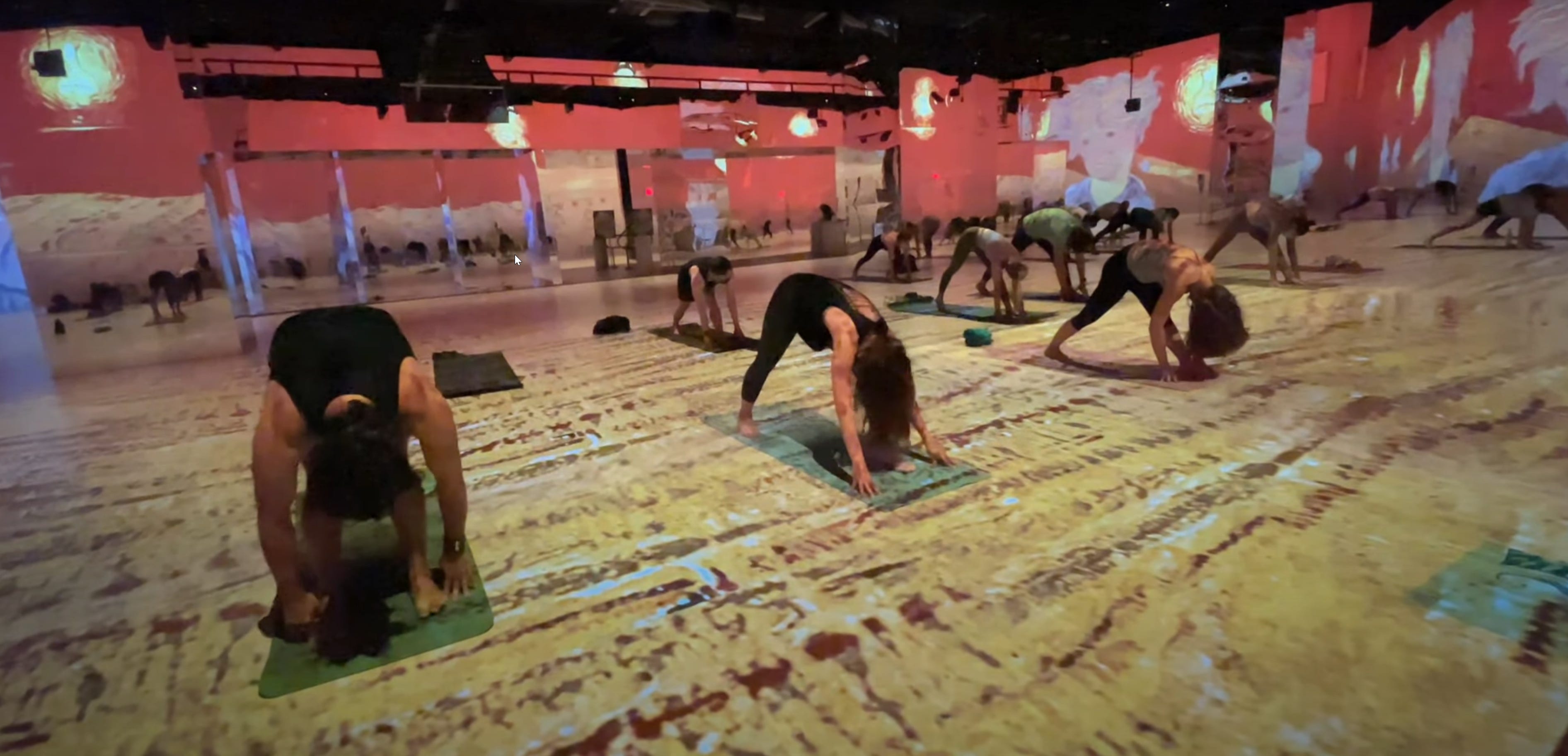
Afterward, we’ll cover Bishop’s most recent book, Disordered Attention. In this book, she suggests the possibility that the attention economy has spurred an evolution in spectatorship. Bishop wonders whether art audiences have now evolved beyond “focused” attention in the same way that we once saw the world without the vanishing horizons of single-point perspective, or how we experienced performances before the technology of modern theaters compelled viewers to direct their undivided attention at a single spectacle on the stage or screen in front of them. Instead, Bishop proposes that we are now “ambient” observers, always in more than one place at a time (a virtual, phone-based place along with the physical space around us), and the art that’s been made in response to this can be categorized in four genres: Research-Based Art, Performance Exhibitions, Interventions, and Invocations, all of which have their own “strategies,” “modes of attention,” “effects,” and “methods” that differ from our preconceived notions of how artwork traditionally functions in society.
These texts each offer their own prescription for approaching creative work at a point in history when the things we choose to look at, our judgments, and the networks over which we communicate are valuable resources in a labor economy that has stopped distinguishing between consumers and producers. As Berger put it in 1972, “the meaning of paintings is no longer attached to them; their meaning becomes transmittable: that is to say it becomes information of a sort, and, like all information, it is either put to use or ignored.” Clearly this has become true of all media, and if we know one thing about information today, it’s that if we ignore it, someone else will put it to use.
I plan for the short essays in Abstacktion to appeal to different readers for different reasons. Some might want nothing more than a few sizzlin’ book recs, in which case you already have them (check back for new ones). Some might want to treat this as a highly suss and uncredited (but free!) class on art in the age of big data, following along as I attempt to write through the connections and contradictions of networked media today. And some people might look to a Substack like this one to process the more upsetting realities of today’s circumstances in a way that is not totally frivolous distraction but is also not hopeless headline-doomscrolling. Frankly, whatever the reason, if you’ve made it to here, I can pretty much guarantee you’ll enjoy the rest of the series, so look out for Abstacktion Episode 2, which should be available next week at about this time.