ABSTACKTION, episode 2.5
NAXOS AND LANTERN

Summer of Sleep
Trust me, I’m working on Abstacktion, episode 3, for whoever’s out there that might someday feel curious about that kind of thing. But until recently I’d been tied up in the production of this group show that Shelby and I, along with our friend Naomi, set up in Portland, Maine. The show was called Night Vision and took place at Light Manufacturing over the final week of July.
Night Vision included two of my pieces, and I thought I’d quickly indulge in some public journaling about the thoughts I had while making them.
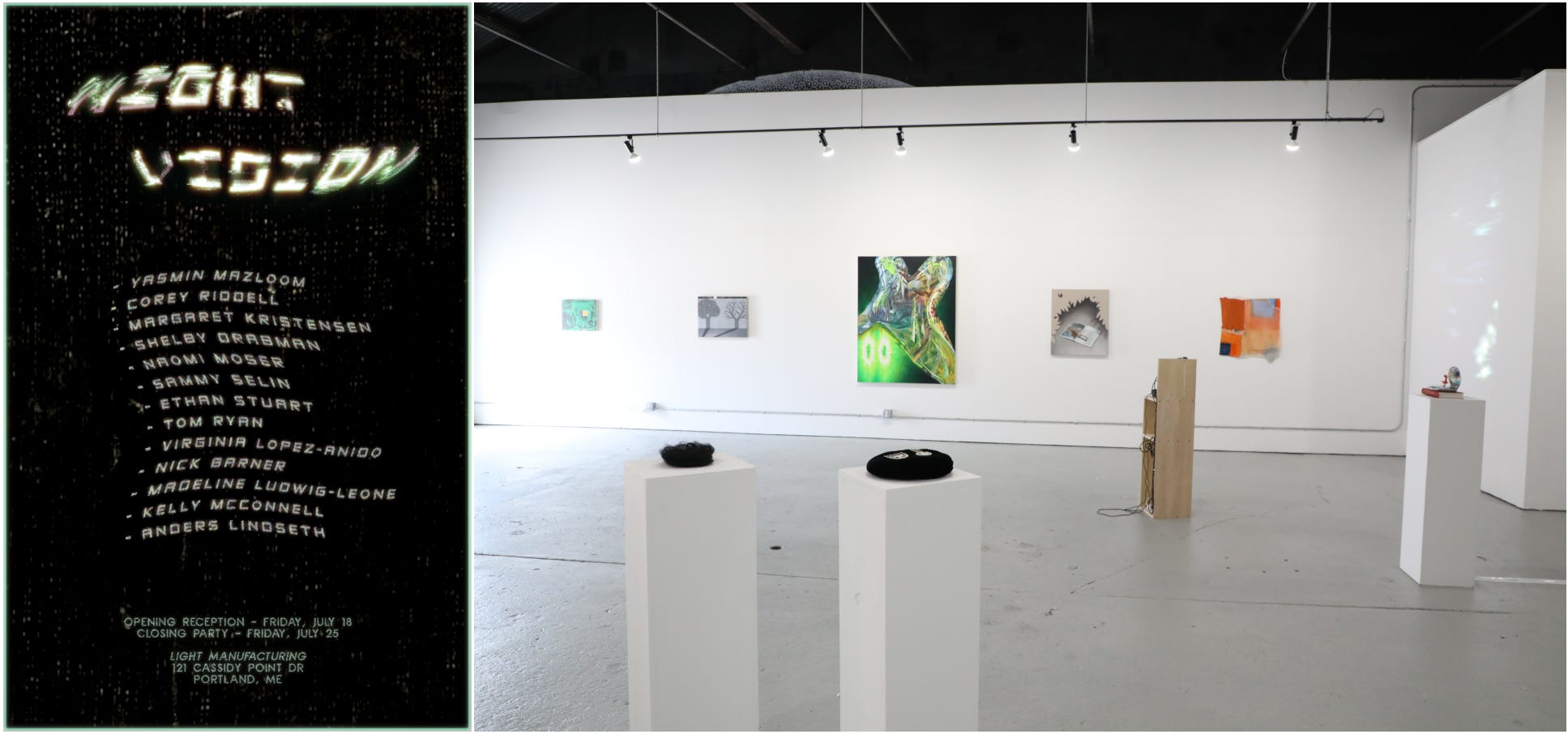
The first sculpture, titled Lantern, is made of epoxy and depicts a Japanese yōkai called The Shirime (or “Buttocks Eye”), and my version of this creature comes equipped with a sunset lamp embedded in said orifice. I’ve written about that piece before, so I’ll focus on the next one here, but what follows pretty much applies to both.
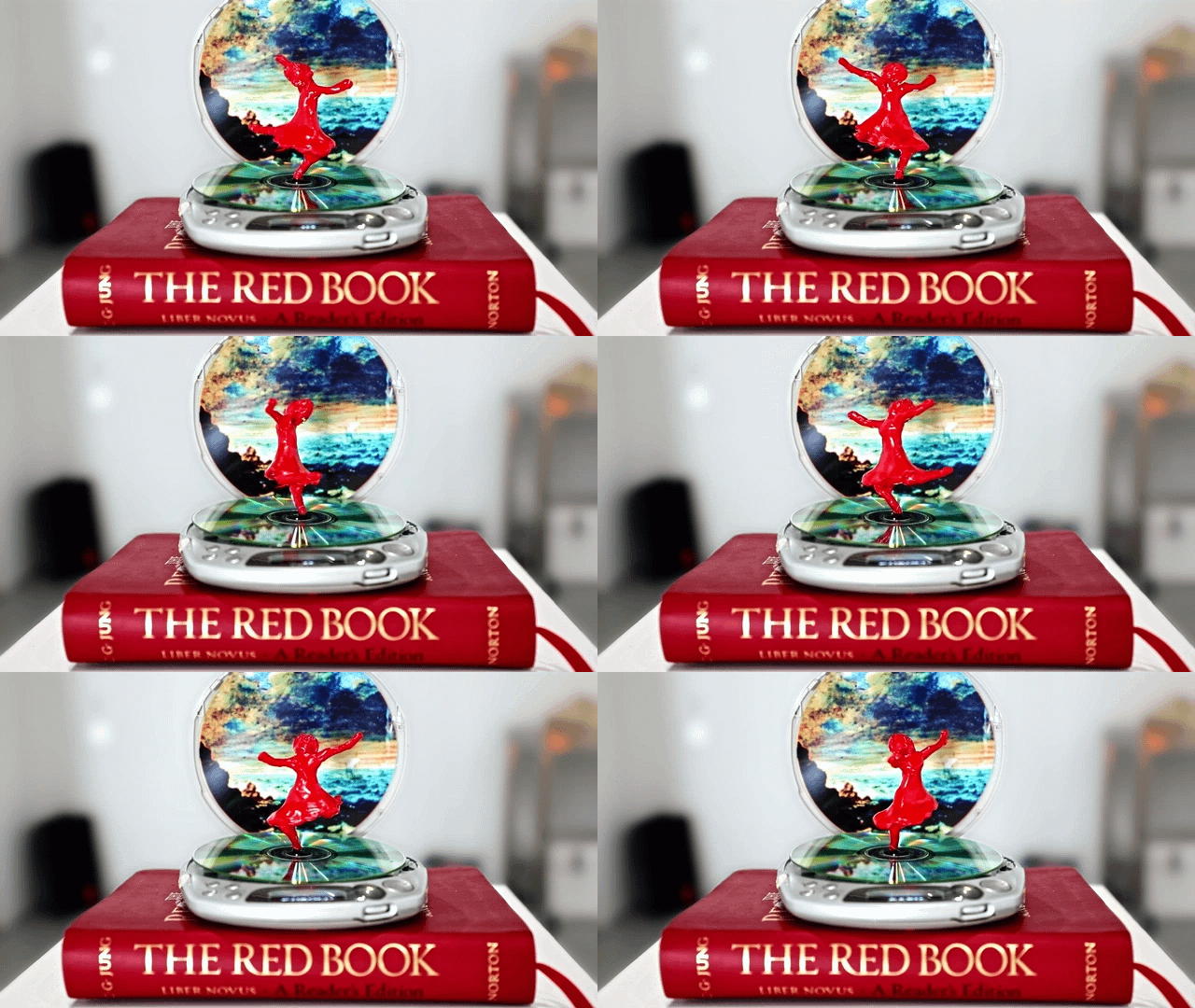
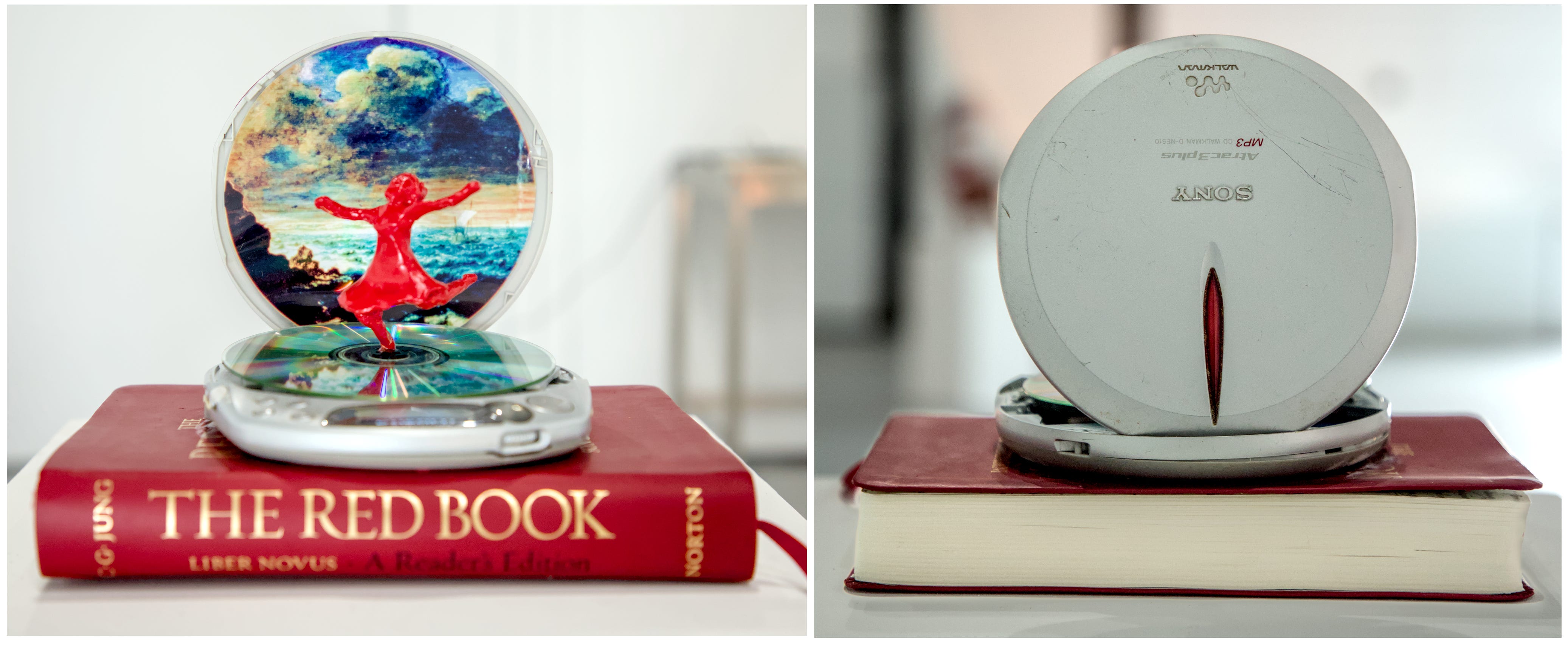
The other work, Naxos, is an assemblage of mixed materials: one Sony Walkman, a CD-ROM, an epoxy figurine of a dancer, a cropped photo of the 17th century painting Bacchus and Ariadne on the Island of Naxos by Cornelis van Poelenburgh, and a copy of C. J. Jung’s Liber Novus (Red Book). The piece also includes custom electronics that repurpose the LCD screen of the old Walkman to read out: “EVER LIVE YOUR WHOLE LIFE IN A DREAM?” instead of, like, “play”/“pause”/“track 1”/etc.
Both of these works came from sleep. In each case, I woke up one morning with the whole concept in my thoughts, entirely complete besides a few technical challenges I knew I’d be able to work out. While this happens to many artists, the ones who claim to make work about dreams often seem hesitant to admit when an idea—especially a successful one—dawns on them while sleeping. Scientists, meanwhile, are frequently giddy to tell how their most brilliant insights came to them first in sleep.

David Lynch was one artist who wasn’t afraid to admit he’d dreamt an idea, and Jung—more or less an artist as well as a psychologist—was another. But artists who make oneiric work are prone to attributing their methods to systems, or material techniques, or legacies of aesthetic theory that somehow necessitate their being awake when they really get the idea. Even the Western canon’s flagship dream artists, the Surrealists, acted as though dreams were too available, not exclusive enough. Everyone dreamt, after all: callous bureaucrats and Hitler too. What was the value in that?
What Have I Done?
Art and identity have a longstanding on-again-off-again relationship that any social worker would flag as abusive. Sleep is a suspicious third party to this dynamic. If our identities accompany us in sleep, they’re prone to instability, and more often act as totally transparent fantasies, inessential and incidental. This is not how we tend to feel about “ourselves” when we’re awake. When we sleep, if we “dream an idea,” or if we wake up “remembering” an idea that we did not dream, our rational intellects may struggle to attribute origins to these notions. We didn’t do that… so where did it come from? To make sense, we hastily revise. Literally before we know it, we’ve taken what in sleep was a whole and complete thought, and we’ve translated it into just the seed of a concept, or inspiration for something, as if we’d heard about it in an early morning lecture.
Instead of going back to bed, then, artists who comment on, or represent, or “conjure” the Dream World employ eccentric tactics for approximating the sleeping mind without leaving the safety of their stable self-awareness. Some of these techniques include the Surrealists’ Paranoiac-Critical Method, the Spiritualists’ Automatic Writing, the Theosophists’ Thought Form Diagrams, the Dadaists’ Chance Operations, and performance genres in which an artist literally performs sleep or the alarming lack of it—Marina Abramovic, Chris Burden, and more contemporary “durational” performers.
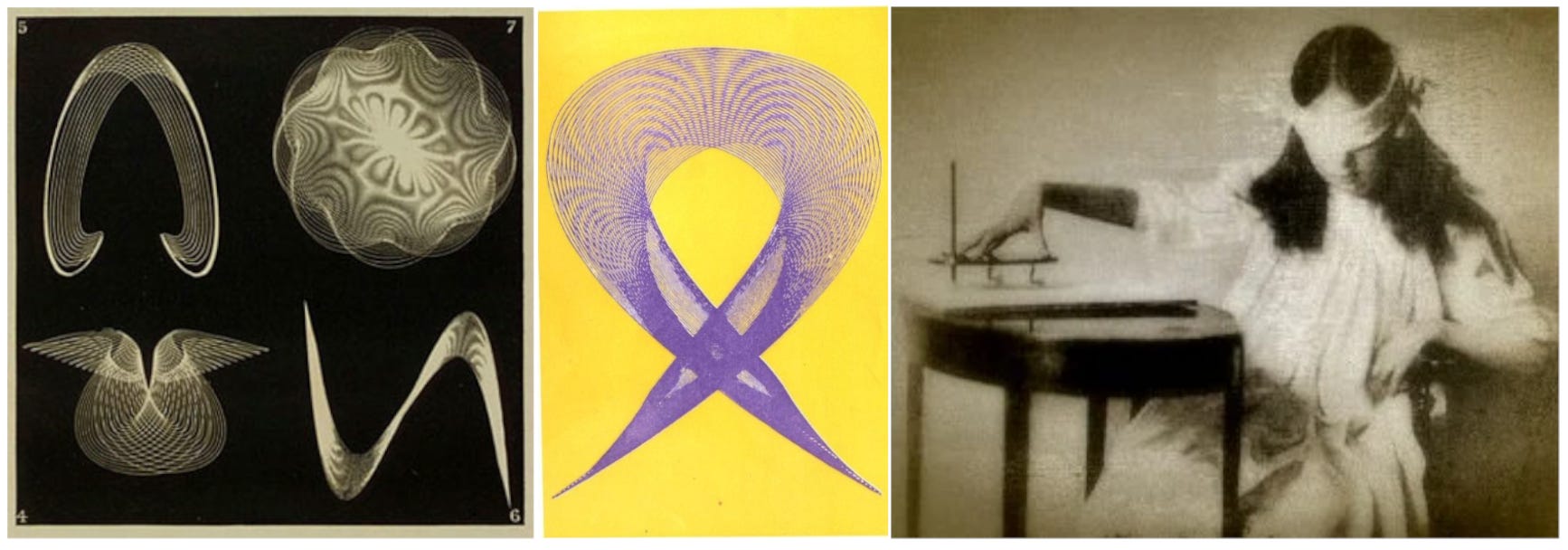
There are some modern traditions (like The Hudson River School of landscape grandeur, Laszlo Moholy Nagy and Vasily Kandinsky’s new abstract iconography, and Agnes Martin and Mark Rothko’s textural meditation aids) that approach the Spiritual, the Sublime, or the outright religious via similar methods. These involve representations or invocations of “the numinous,” “the wholly other”, or “oceanic feeling,” which William James made culturally relevant to secularists through his book The Varieties of Religious Experience. I think these are a little different from dream work for the possibly obvious reason that dreams are different from divinity or epiphany.
I also think, though, that there is a more unsettling assumption behind the use of artistic expression to draw beauty from the meditative present, or worse, to simply depict the artist’s internal experience of ecstasy and transcendence, and this assumption also underpins the representational and symbolic use of dreams in art.
Center Yourself
In the 20th century, it’s fair to say Keynesianism did not wait outside the door of the art market. The very existence of America hinged on the pervasive assumption that the value of our cultural capital would continue to purchase unchecked exceptionalism from a world organized under homeostatic competition. The many counterpoints to this lie appear obvious in retrospect, and one of them was the psychoanalytic topography of “the Western individual.”
When public relations, advertising, and Freudian theory joined forces to prioritize the growth of capital over the sustainable health of human beings, the model for the psyche came to look something like an oil well or coal mine. On the surface, before you dug down, there was nothing unique or valuable, just a tract of land connected to so many other, identical acres. Beneath the surface sat a nearly bottomless substrate into which you could tunnel. When you did manage to claw down there, the further away you got from “society,” the more “into yourself” you went, the more you would unearth the primal individuality that made you you. The value and extent of this individuality was directly correlated with how uniquely yours it was, how far down you could dig, how complete an escape you could make from other people. The deeper you tunneled, the more you would learn about yourself.
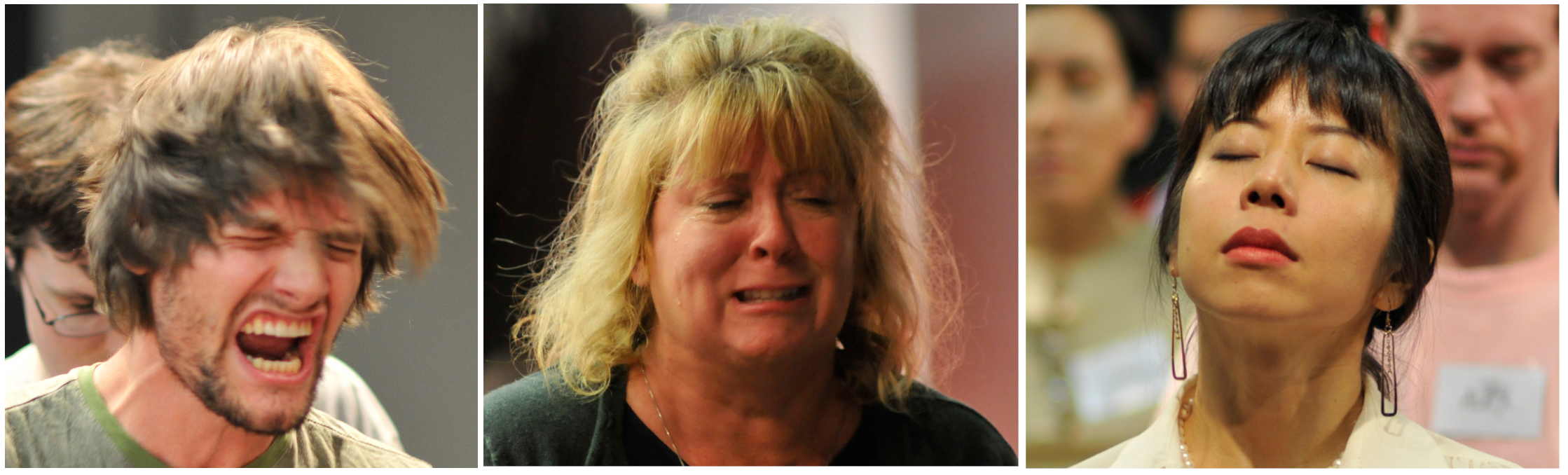
Once found, your essential identity could be either hoarded or sold like wealth. It could be hoarded in the form of solitude and peace, which would provide meaning and satisfaction. It could be sold in the form of creative labor, which furnished the monetary comfort required to drill deeper and uncover more about your true nature. Creative labor could be sold in markets that were not traditionally thought of as creative, like at a car dealership by a charismatic salesperson, or certainly in spaces of technological and military development, where hero thinkers got paid mega bucks for their unique minds.
I Love That For You
The absolute purest form of creative value production was art. The process of artmaking allowed a person’s buried reserves of subconscious identity to be directly forged into fungible assets through a very cool process known today as “self-expression.”
Expressionism, especially Abstract Expressionism, which consisted purely of what is often called the artist’s “autographic gesture”—as if they had belayed into the depths of their unique souls and used a crayon to rub their own logo off an ancient tablet—became the loadstone of America’s creative future. AbEx (like a ticker symbol) was the splashy, large-scale, investment-smart rebuttal to communist theories of creativity that purported to function collectively.
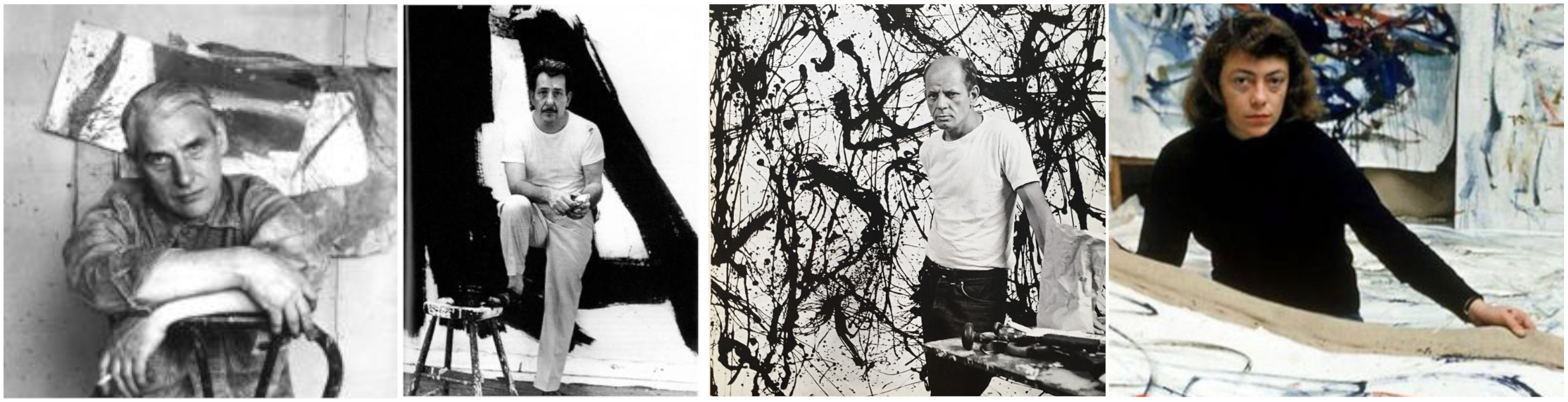
AbEx was secular and therefore did not step on science’s toes. It was tokenized, with each artwork accounting for an almost measurable quantity of the artist’s creative labor, so it was totally compatible with commerce. Best of all, AbEx demonstrated a relatively left-wing type of libertarian freedom. Fully non-objective and “all over” in its abstraction, the work had no specific meaning that could possibly offend. AbEx paintings were demonstrations of big selves being themselves.
I won’t swerve too far into the whole conspiracy theory of Jackson Pollock, the CIA, Harvard’s “Creativity Studies” program, Clement Greenberg, the American Committee for Cultural Freedom, and the intelligence-backed public relations campaign to champion AbEx in opposition to Soviet Realism.
With reasonably compelling evidence, some claim this is what led to the style defining America’s conception of modern art to such an extreme degree that, even though AbEx really committed teenage suicide in the ‘60’s, compositions like Jackson Pollock’s, Franz Kline’s, Helen Frankenthaler’s, and Willem de Kooning’s are what nearly everyone in this country think of when they think about art from WWII until today.
If you ask me, though, some of the shady details of that counter-history, which can be argued about indefinitely, and result in clickbait headlines like Did the CIA Invent Modern Art?, mostly just distract from the ideological connection between the American culture industry and the role of art in postindustrial society. Regardless of any group or government’s intentions, American art in that time does seem to have reinforced a conception of the subconscious self that mystically originates in isolation from society. Not the Collective Unconscious, but Individual Intuition. In this view, we were each solely responsible, not only for our outward actions, but for cultivating a walled garden within ourselves where we could take refuge so that we wouldn’t burden anyone else. Art, we learned, could represent this place through color fields and brush strokes.
There is a parallel impulse between the AbEx notion of mining self-expression from the individual subconscious and believing that dreams hold a rarified quality which stands to be “expressed” in the world of the mundane. Whereas Americans are mostly happy to attribute certain types of artistic abstraction to the former (and value those styles dearly), we continue to disagree on the relevance of what occurs in sleep, and what should be done with those experiences.
Sleep Studies
In contrast to AbEx, art movements such as the Futurists, the Surrealists, the Dadaists, and the Situationists, when faced with the extreme violence that took place in the first quarter of the twentieth century, lost much faith in Western thought altogether. Seeing how we humans were highly capable of destroying each other for inarticulable reasons, these movements recognized that our unconscious lives were collectively entangled in consequential ways. What exactly was being expressed, then, when an individual created a work of art in this kind of society?
Led by artist Filippo Tommaso Marinetti, the Futurists saw the modern positivism of Europe’s upper classes as an unsalvageable attitude fated to self-destruct. They embraced the decline of the Bourgeoisie by fantasizing about a world where the industrial revolution would transform humanity into a force equally bestial and mechanical, destined to carry out perpetual ruin until every one of us met a fiery end. Wars would never cease—in fact, war would be culture’s single value—and the strong would subsist on the sacrifices of the weak. For the Futurists, this was utopia, a pavement pounding path to freedom from the oppressive demands of modernity. Futurist art reflected a valorized man/warrior/machine, like a militarized ancestor of contemporary transhumanism.
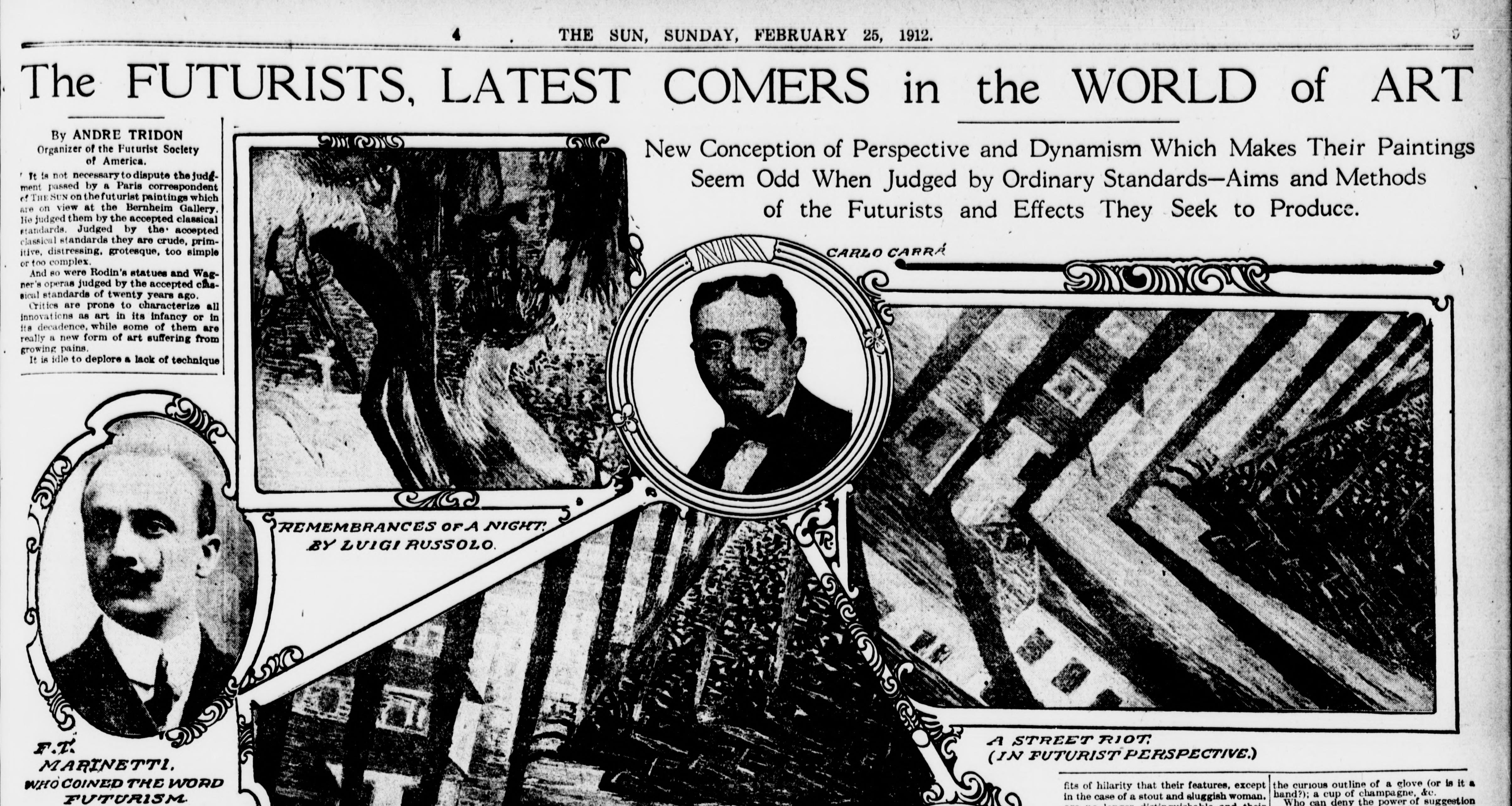
For the Futurists, there was no subconscious to be found beneath the surface of the self. Identity was irrelevant, and self-awareness was an accident, soon to be eclipsed by artificial beings toiling to produce advanced technology that would then be destroyed in perpetual war. Laying the aesthetic groundwork for Mussolini’s fascism, creative output could be seen as the human apparatus fulfilling its function to produce more power at greater efficiency. Futurism was like a right-wing, negative collectivity where individuals were not valued for their ineffable souls (and certain individuals, like women, were not valued at all), but we were all equal under the twin dispensations of technology and death. Art could, and should, hasten the sublime apocalypse.
More hopeful and humanitarian, poet André Breton and the Surrealists nonetheless agreed that Eurocentric thought was probably a dead end. If left to its own devices, it seemed likely to end in the hellscape described by the Futurists. But this was not utopia to them. They searched for alternative modes of ordering the world that might avoid the horrors. In The Surrealist Manifesto, Breton claimed that the human psyche was caught between two realities, one true and one artificial. The true reality, or “surreality,” made up our interior world, and the artificial one was what we encountered in day-to-day life. Surrealism, he wrote, was the attempt “to present interior reality and exterior reality as two elements in process of unification.”
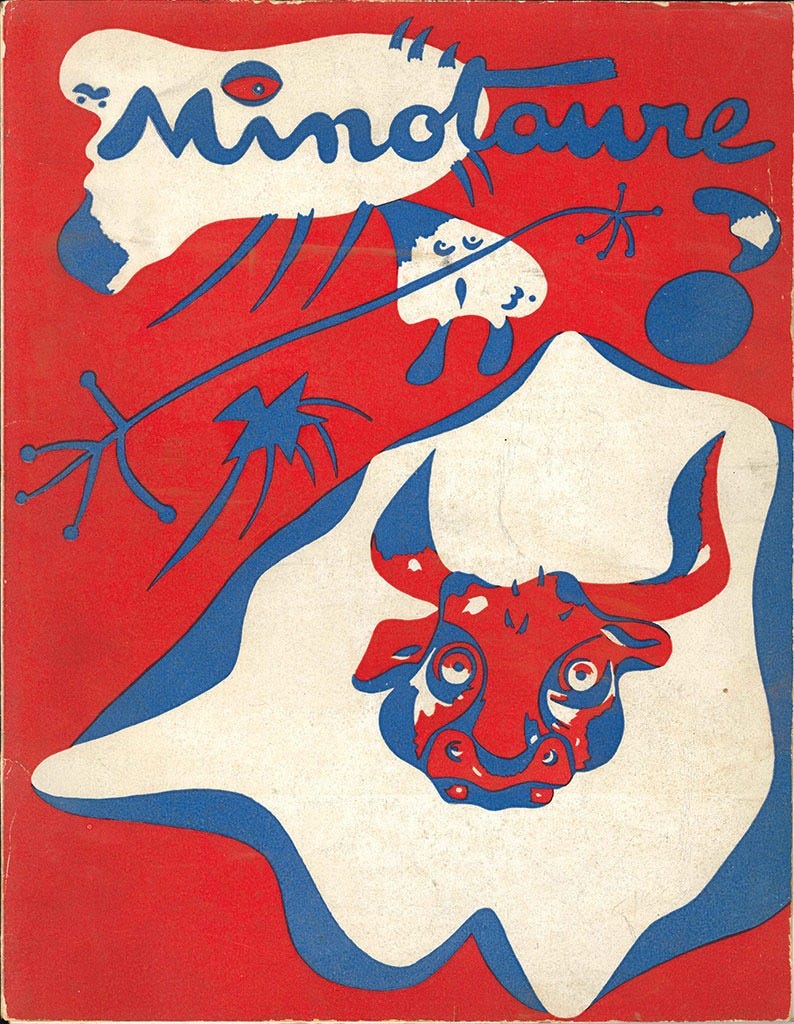
Taking inspiration from marginalized forms of thought, the Surrealists looked toward madness and dreams for a way to understand that “interior reality.” Guided by the anthropological writing of Marcel Mauss, they learned that culture was organized around a set of definitional myths, something like the Archetypes proposed by Jung. In order to change culture, the Surrealists thought it might be possible to read the myths of the world like an insane person or dreamer might, bridging the gap between inner and outer worlds. But if you were either sane or awake, you were sort of left to imagine what that looked like. As with any art movement, Surrealism was not a clean break from its precursors, and the artists wound up leaning heavily on a style called Symbolism to represent how dreams and madness should be painted.
Some of the club members—and the Surrealists were literally a club—took the job of going temporarily insane pretty seriously. Salvador Dali invented something called The Paranoiac-Critical Method, André Breton mused about carrying out a mass shooting, and George Bataille begged his friends to take him out into the woods and slice off his head with a ritual sword. Ultimately, though, their madness was not contagious; probably the opposite. And their visual art, though extremely well-received (Breton’s nickname for Dali was “Salvador Dollars”), became more a matter of whimsical entertainment, not really offensive to the status quo, and certainly not antithetical to Enlightenment values in the way they’d hoped
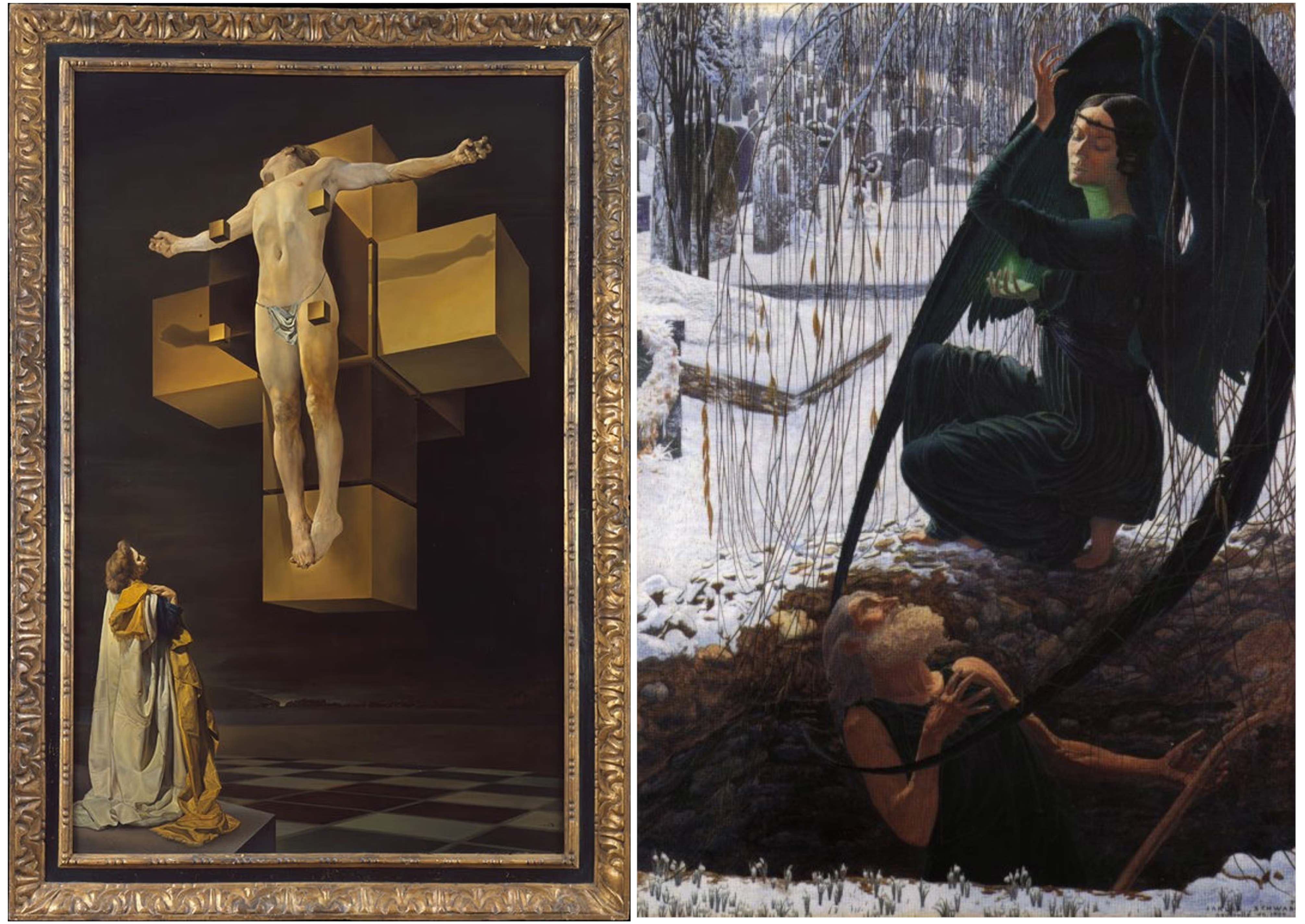
Possibly due to their group’s exclusivity, different Surrealists interpreted unconscious experience in different ways, but a core mission united them: to somehow reconcile the artifice of cultural programming with the obscured truth of our collective psychic existence. On the other hand, a parallel art movement of the time, the Dadaists, did not necessarily endorse the existence of a “true” reality hidden somewhere behind the veil of perception. The Dadaists were a fractious, leaderless, anarchic movement of artists, writers, and performers who responded to the First World War by suggesting that unchecked systematic thinking would always generate an unstable illusion of society. Being illusory, society would then collapse, and the whole world would suffer.
Whether the Dadaists considered this situation avoidable is unclear, but they believed that artists could punch holes in this grand cultural illusion that justified so much violence by manifesting absurdity within it. You didn’t have to be insane, and you didn’t have to mutate art history by swapping out the images of real life with ones from dreams. All you had to do was not act logically, not think logically, and make art whose only rule was to negate and destroy any form of organization or system that began to appear inside it. Marcel Duchamp, the most widely recognized of the Dadaists, described his method in simplistic terms. “I refused to accept anything,” he said, “doubted everything.”
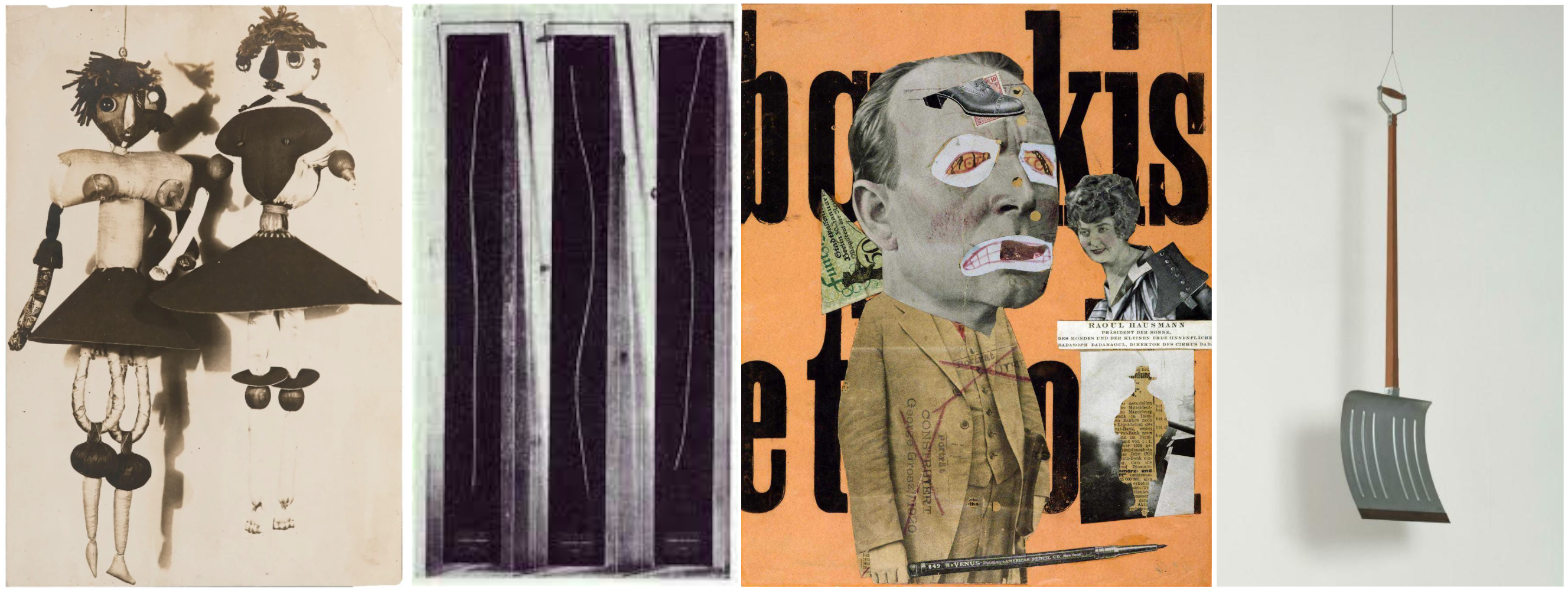
In the first Dada Manifesto of 1916, poet Hugo Ball reclaimed the Futurist dictum by asserting that Dada would be “world war without end… revolution without beginning.” In pursuit of this never-beginning revolution, Dadaists utilized nonsense poems, illogically juxtaposed collages, performances whose sole objective was never to have happened before, techniques of chance such as drawing with lengths of thrown thread, assemblages of trash, and “readymades” that involved resituating non-art objects in new contexts. Dadaists themselves harbored no preconceptions about the movement’s aesthetic. If a style arose, the response would be to abandon it.
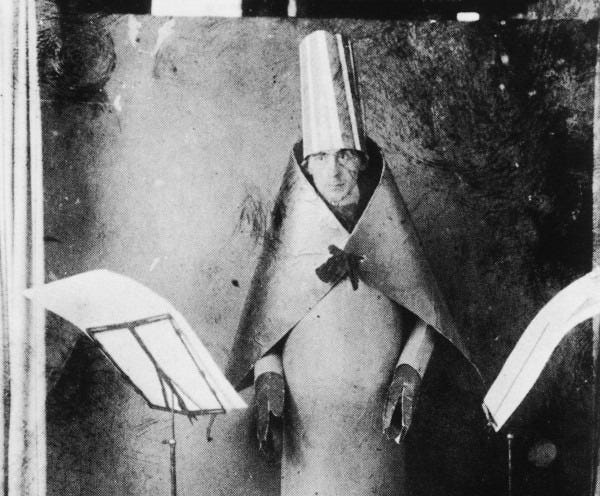
Surrealist André Breton, in his essay Lighthouse of the Bride (p. 66), conceded of Duchamp and Dada, “never has a more profound originality appeared more clearly to derive from a being charged with a more determined intention of negation.” While the Dadaists did not necessarily care about dreams or sleep in the same way as the Surrealists, by “negating” everything, by denying the forgone nature of reality itself, they arrived at a method for artmaking that much more closely resembled that of a sleeping mind. The Dadaists suggested that an alternative mode of existence might be accessed not through approximations of madness, reenactments of magic, or the reshuffling of already much-reshuffled mythological symbols—and certainly not through a surrender to mechanized force—but by leaving behind the world as it was ever known to them in order to find out if a different world already existed in its place. Something like falling asleep and seeing what happened, not particularly expecting to remember it.
Break Yourself
Today we have a lot of thinkers touting sentiments about the perverse nature of Enlightenment thought and the suicidal project of Western imperialism in a way that mirrors the European avant-garde of the early twentieth century. As in that period, some extreme critiques of the Western identity fall to the political right, and some to the left.
Echoing Marinetti’s Futurism, many offer an “accelerationist” strategy for moving past the current social maladies. Assuming self-destruction is inevitable, they look for all kinds of ways to bring on the collapse. And in the meantime, they draw up charters for society in a post-apocalyptic Dark Age, which tend to look a lot like the old hierarchies of the real Dark Age. Some of these people have gained political influence in America, and now they are testing the strategy, using democracy’s self-destructive qualities to actually destroy democracy. Having played out the scenario in simulation, and having studied the twilight years of past societies, they understand that when an empire like the U.S. collapses, the results are vastly unequal. Their vision of the future is, put simply, a society of haves and have-nots, and these unchangeable roles will be assigned at the outset.
Even though we find this eerie reverberation of Futurism’s violence in right-wing accelerationism, the ruling class of America today is without any art or artistic vision whatsoever. They have no artists in their ranks, and there is no creative labor behind their propaganda. In a paradigm of negation (almost like that of Dada, but choosing to glaringly not negate capital) the Neoconservative movement believes that art does not exist, except as a category of finance. In this model, an individual’s subconsciousness is composed of data, and society is an equation. Each of us might dream absurd fantasies of countercultural possibility, but these dreams are only relevant insofar as they can be used to control people by diagrammatically understanding them. Visualized as walking databases who exhibit “emergent consciousness,” we citizens are never free to transcend our stations as components in a technology that someone else owns.
In our search for freedom, futurity, and art, we can think of dreams as only one of the infinite occurrences at home in the realm of sleep. Unremembered sleep, non-dreaming sleep, when your body is hypothetically restoring itself and your mind is doing fuck-if-you-know, is like a core flaw, a necessary error in a program otherwise set to run continuously as the same person for a whole lifetime. What is utterly unknowable to us will also not be known to a database that conceives of us, and sleep is an unknowable world.
Drifting Off
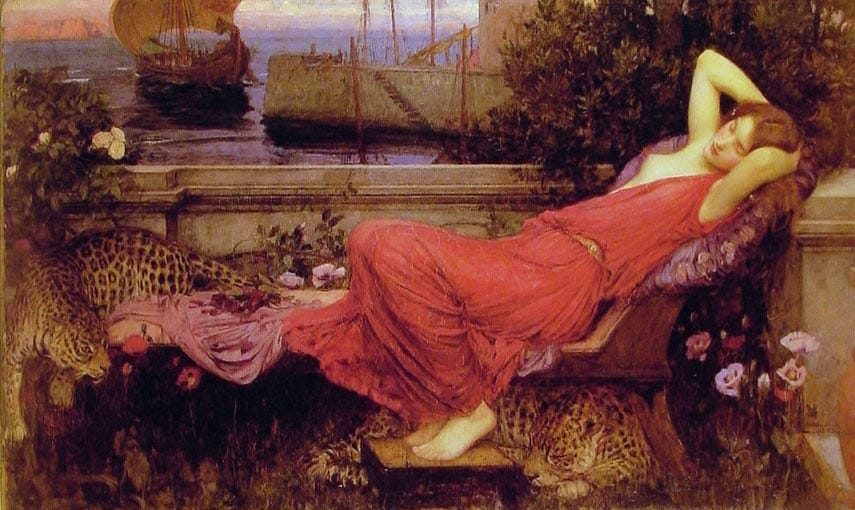
In the frequently depicted tale that inspired the Walkman piece, Ariadne—who once provided the thread that traced an unbroken path through the meandering labyrinth—lay alone and abandoned by Theseus on the island of Naxos. She was left there to die. But when she woke up, she was rescued by the god of wine and dancing. She found herself free.
Maybe there is a source of hope in accepting that every night the thread is cut for everyone. It strikes me that artwork is often a gift we are given, courtesy of whoever we once were and aren’t anymore. Maybe creativity doesn’t come from someplace deeper, it comes from someone else.